All Deviations
All Deviations
  • Status: Official Beta Tester
  • Wannabe Novelist
  • Male/United States
  • Invisible
  • Deviant since Jul 14, 2005, 2:54 PM
  • Subscribed until Nov 5, 2009, 8:04 AM
  • 161 Deviations
  • 12 Scraps [browse]
  • 4,944 Deviation Comments
  • 1,577 Deviant Comments
  • 58 News Comments
  • 14,037 Pageviews

Sharkey

Recent Deviations

Browse Gallery
Search

Submitted News

Desktop Screenshot

Recent Visitors

Come Into the Fold ... All are Welcome.

Journal Entry: Wed Aug 27, 2008, 6:46 AM

New Ones ... So Tender, So Innocent ... .


We have new converts to our happy little fold.

Welcome them, children and believers -- they’ve made a bold step into a brave new world. A world of beauty, power, a world of freedom and joy.

A world without adverbs.

=Kira73
*peterdawes

Welcome them. They are now part of the collective.

Are you?

Resistance is futile ... you will be assimilated ... .

-JDT-


Writer's Helps


Because some of you have expressed interest in having me do some digging on your behalf, and finding some tips-'n'-tricks on grammar things, I figured there's no time like the present to start. Here's where they'll be posted.


Adverbs in Fiction

Adverbs are the endangered species of the adult fiction world. They're frowned on like putting a Baby Ruth bar in a punch bowl at a wedding reception -- not a good idea. They're also indicative of weak writing ... but why? This article covers why adverbs are evil and what you can do to avoid using them.

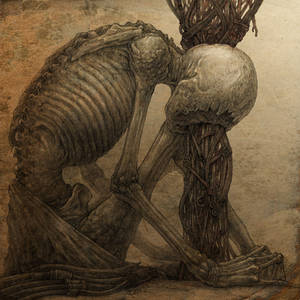
Adverbs are dying. Over the barren wasteland of Adverbia, a cold sun sets over the crest of tangled, bony branches on gunmetal-gray trees, silhouettes of mountains in the distance, and long shadows stretched over cracked, curling pads of parched clay.

Why? Why are adverbs relegated to the path of the dinosaur in fiction writing? What's so doggone wrong with adverbs, anyway??

Well, there's a few simple reasons for it -- and maybe there are a lot of reasons for it, but I've identified a few simple ones.

The goal here, of course, isn't to make you feel foolish or inadequate if you're one of those adverb-happy writers, but to demonstrate a better way for you to improve your writing. For those of you still in school below the University level, think about this: you can blow your English or creative writing teachers out of the water with this information, and won't you be the envy of the rest of your adverb-reliant classmates?

I know, I know, I'm not getting to the point. And that opening is a little vague. Bear with me, though, and I'll do my best to show you why adverbs are evil and how you can be a superhero of writing by getting away from them.

(Translation: Adverbs are for amateurs, and you want to be a pro, right? So follow along and become a better writer. I sure did.)

So, what's an adverb in this context, and what do we do with them? How do we know them to avoid them?

Let's start with some general definitions. Nothing hyper-specific, just painting in broad strokes so we're all on the same page when the word "adverb" keeps popping into view.

Definition

An adverb is:

An adverb is a part of speech. It is any word that modifies any other part of language: verbs, adjectives (including numbers), clauses, sentences and other adverbs, except for nouns; modifiers of nouns are primarily determiners and adjectives.
-Wikipedia.org


  • the word class that qualifies verbs or clauses

  • a word that modifies something other than a noun
From [link]


a word belonging to one of the major form classes in any of numerous languages, typically serving as a modifier of a verb, an adjective, another adverb, a preposition, a phrase, a clause, or a sentence, expressing some relation of manner or quality, place, time, degree, number, cause, opposition, affirmation, or denial, and in English also serving to connect and to express comment on clause content.
-Merriam-Webster Online


I could go on and on here, but let's sum up:

An adverb is a word used to modify anything other than a noun (person, place or thing). And, to be more specific, it's a word used to modify (or strengthen) a verb ... dun-dun-duuuuuunnnn!

(Notice the scary, "oh noes!" musical insertion? There's a reason for it. Read on.)

Before we get too deep into the topic, I'd like to point out that adjectives, when overdone in a similar fashion, are just as prone to distaste as adverbs. But I haven't learned adjectives yet, so you get adverbs. When I grow up and get older you can have adjectives. Or you have to go get them yourself.

Once more:
An adverb, for the purpose of this article, is a word modifying anything except a noun -- verbs, adjectives, clauses, etc. -- and end with "ly" for the most part.

With that out of the way, let's move on to why they're evil.

The Evil of Adverbs

I've had a lot of folks tell me they don't understand my complete and utter hatred of "ly" words ... Adverbs. Some don't understand how an "anathema" came upon these poor, innocent li'l words, and some think I'm just off my rocker to be so blast-happy where they're concerned. It's a fair question, and it wasn't long ago at all that I was as dependent on adverbs in my writing as an infant on its mother. I bloated my word count with endless strings of them, hammered into place one after another like train cars.

But, dear friends, there IS an anathema on adverbs, and I didn't proclaim it. There's at least one great reason for it.

It's an indication of weak writing.

I know ... how can this be, when Mrs. Swingingjowls taught you to use them when you were in elementary school?? I mean, Mrs. Swingingjowls, yo! She wouldn't steer you wrong! She's the one that set you on the path to being a writer anyway, and told you how much talent you have, and all that. What're you saying -- that Mrs. Swingingjowls was wrong??

Well ... yeah.

See, Mrs. Swingingjowls taught you adverbs, then emphasized their use as modifiers to help your sentences become more descriptive, more visual to the reader. I mean, what's better, "She walked down the alley" or "She nervously walked quickly down the alley"? Let's face it, the one states a fact, the other describes a mood.

Or does it?

Mrs. Swingingjowls enjoyed reading how Spot chased the ball quickly and playfully in the yard because the alternative was Spot chased the ball in the yard, which is boring, and she was required to teach you the part of speech and how it works. But she wasn't teaching you adult fiction writing, and how to strengthen your prose for the rigors of the publishing industry, or even how to make your descriptions better. She just taught you to make your existing sentences descriptive.

You should know now, however -- Mrs. Swingingjowls expected you to continue your growth beyond her elementary instruction in parts of speech. Spot running quickly and playfully in the yard was great in her class, but if you're still doing that sort of writing, Mrs. Swingingjowls would be disappointed in you.

Adverbs Modify Verbs

The real question to ask isn't whether Mrs. Swingingjowls was right or wrong in teaching you to modify your sentences with adverbs. The question is, why are you modifying your verbs with adverbs?

This is an easy one to answer, when you think about it:

Because your verbs are weak.

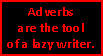
Mark Twain once said, "Adverbs are the tool of the lazy writer." Amen, Mark.

See, what's going on is, you're using a word that doesn't really convey the sense, the feeling, the mood or whatever, you're hoping to get across to your reader. "Walk" isn't a very exciting word, and it doesn't get across the antsy feeling you're trying to portray in your description, so you make it "walk quickly" or "quickly walked". You want your reader to see the force, the power in your characters' argument, so instead of saying "they shouted across the table" you say "they shouted angrily and vehemently across the table."

The problem is, the verbs you've chosen aren't doing the job you wanted them to do in the first place. You don't want your character to walk, you want your character to hasten, hurry, quick-step. You don't want your characters shouting, you want them spitting words through clenched teeth, veins throbbing on reddened necks, molars locked and spittle misting between them.

The reason you're reaching for adverbs to tell the story is because the verbs you've chosen are too weak to do it for you. The adverb isn't the solution, however. Strengthening your writing is.

Think about this: If the verbs you're using to describe the action in your story are weak and flimsy, the action description may be weak and flimsy too.

You wouldn't be writing something with the intent of being flimsy or weak, would you? The reason you're grabbing adverbs in the first place is because of discontent with what's being said without them, right?

Why bother with modifiers for words that aren't cutting it in the first place? The real crux of the problem is finding the right actions and descriptions for those actions, so that modifiers -- adverbs AND adjectives -- will be needed with rare and prudent infrequency.

When you're writing adult fiction, the need to limit -- if not eliminate -- adverbs altogether becomes pretty obvious. What adult wants to read a grade school type of book?

No, adults want to be pulled into the story, and be engaged by it. The use of adverbs won't get the job done, and loses the reader early on.

Show, Don't Tell -- Adverbs are NOT Good Description

With the evil adverb dragging your writing down, it's now safe to say that using adverbs isn't a way to make a lousy description good. It's a lazy way to make a weak description obvious.

What adverbs do, in a nutshell, is tell the reader what's going on in the story. That's NOT what you want to do.

"But -- I thought I was TELLING a story here?"

No. You're not. If you're a serious writer, you're not "telling" a story, you're SHOWING a story.

Don't be lazy. Be specific. Use specific nouns and verbs to do the bulk of the work in your writing. By letting good, descriptive words do the heavy lifting, the occasional adjective and adverb aren't the problematic, amateur-flagging beacons common in weak writing. And, by finding better ways to say the things you want to say, you will go from writer, grade-school level, to UBER-writer. If you're still IN school, imagine the stunned look of awe your next creative writing assignment will get when you turn it in with no adverbs and only super-strong, descriptive nouns and verbs punching the reader right in the mouth. Instant "A", kids.

How to Fix Your Writing

We've already talked about things you can do to help -- using specific nouns and verbs to say the things you'd say with adverbs otherwise. But there's more to it than that.

Tricks and Tips

As writers, we have to keep the "Show, Don't Tell" model in mind. We are challenged to expand our vocabulary so our writing doesn't run into the limitations placed on us, and become replete with adverbs and adjectives that tag us as hacks or amateurs, or amateur hacks. A written piece is called a "work" because there's no room for being lazy. Try and find specific examples in your own writing when you used an adverb, and figure out why. Which word isn't doing the job you wanted?

To help you in this, here's a trick you can use:

Open your web browser to Google. Type in the word "define", a colon, and then the phrase or word you're having trouble with. For example, to find out what "ichthyologist" means, you'd type:

define:ichthyologist

Note there is NO space between the colon and the word to define.

Google will search the web and return references for that word from every site it can find. If there are no results, it's a pretty good bet you either misspelled the word, or it isn't a real word (like "irregardless").

Do this for the adverbs you've used, or the verb-adverb combination phrases. "Walked quickly"? How 'bout "darted"? "Pushing lightly?" How 'bout "pressed" or "caressed" or "traced"?

You can do it. Google will help.

Another thing you can do is just expand your vocabulary a bit. Read. Read things you love, but read with an eye toward the way it's written. What do you like, dislike, how did the author mete out their adverbs and adjectives? Some authors say don't use them at ALL if you can; others are pretty liberal with them. As a matter of practice, though, you should be prudent with them and make them rare in your writing.

Rather than fall back on them, work to make your writing the descriptive sort of work adult fiction expects and adores.

How do you do this? Ah, that's a great question, but some answers are reading, crossword puzzles, reading, word find puzzles, reading, playing games like Scrabble or Text Twist, reading, those handy Reader's Digest Word Power things, reading ... did I mention reading? Yeah, reading is good.

Another tool you can use to help is WordWeb. It's a free program you can download and install on your computer, or even to a USB thumb-drive. It's an extensive dictionary of words and related words, shows a list of synonyms and sometimes antonyms, and provides a couple of reference definitions when more than one exists. But it's greatest asset to the writer is its ability to go out to the web and search for more information. Sites like Wikipedia, Wiktionary, etc. are available to the program, and it even integrates with some word processing programs to act as their spellcheck utility.

And, a big one: When you finish writing your chapter, piece, novel, short story, whatever, it's time to make your word processor pay for itself. Go to the Find and Replace feature, and type in "ly " (that is, the letter "L", the letter "Y", and a space; no quotes, of course). Don't be surprised to find more of them than you expected, and don't be lazy about getting rid of them either. Destroy those buggers before they destroy you.

So, I can NEVER Use Adverbs Again??

Well, as tempting as it is for me to say "Yes! You're forbidden from using adverbs again, ever!!", I really can't do that. I have to admit that, used sparingly (see?? see????), adverbs and adjectives have their place. They can enhance and help. But they really should be rare. Don't shoot for one or two each chapter, see if you can get that to one or two each book.

Try to exercise your writer muscles and find better verbs and nouns to say what you want to say. Use Google, use WordWeb, use other people you know who write as resources for new words for old clichés or adverbs and adjectives. Be judicious about what you TELL the reader and make sure you spend most of your time and words SHOWING the reader.

A reader who's shown the story and not told it is more engaged, and happier, at the end of the book.

Good luck, and zap them adverbs!

See ya next time.
-JDT-


Featured Art


We've seen mermaids. We've seen ships. How about some Jellyfish now? Nothing on our planet comes as close to being an alien life form as the creatures of the deep ocean ... and jellies.


Clubs I'm In


:iconvampirewriters:


Stuff I'm Collecting


  • Mood: Dominance

Devious Information

  • deviantWEAR sizing preference: "Tent"
  • Interests: My wife, my children. Nothing else really matters anymore.
  • Favourite movie: Batman (Tim Burton); 12 Monkeys; The Good Shepherd; The Nightmare Before Christmas
  • Favourite genre of music: Classical
  • Favourite artist: Skottie Young, Dan Jurgens, Mark Bagley, John Buscema, Jim Lee, J Scott Campbell, Mike Wieringo, MAD
  • Favourite poet or writer: *PeterDawes, Robert Frost; Stephen King, Joe Hill, Julie Staples, Sherri Cornelius, John Steinbeck
  • Favourite photographer: *Tar-Vanimelde, *BPC73
  • Favourite style of art: Anything really well done, JSC, Joe MAD, Skottie Young, Jim Lee, Brian Hitch
  • Operating System: XP now, Linux when I can
  • Personal Quote: Better to remain silent and be thought a fool, than to speak and remove all doubt.
  • Tools of the Trade: My inconceivable stupidity and clumsiness.

Devious Comments

*peterdawes:iconpeterdawes: 5 hours 33 minutes ago
for you, kind sir: [link]
perhaps not flawless, but an attempt just the same.

--
"And the wild regrets and the bloody sweats
None knew so well as I:
That he who lives more lives than one,
More deaths than one shall die."
- Oscar Wilde
=DarcKnyt:iconDarcKnyt: 19 hours 10 minutes ago
:rofl: I knew I'd getcha, Peter! I knew I would! :lol:

They become very obvious and painful to read, don't they? I'm on a mission to evangelize as many as I can to it ... :plotting:

Don't be concerned; when you have a free moment, it's a way to kill about two minutes, that's all. I know you're pounding away at the next chapter too. I almost feel bad knowing what I'll be doing to it.

Almost. ;)

--
JDT :batman:
My Blog

Now faith is the assurance of things hoped for, the conviction of things not seen. -Heb. 11:1
*peterdawes:iconpeterdawes: 19 hours 16 minutes ago
i just thought you might like to know you have corrupted me.

i picked up a novel today and started to read, but all of these bloody -ly words kept jumping out at me. it began driving me crazy until i had to put the book down and move on to something else.

am not ignoring your challenge, by the way. having a hard time getting over the hill of the middle of this chapter and have been focusing my thoughts and energy there.

--
"And the wild regrets and the bloody sweats
None knew so well as I:
That he who lives more lives than one,
More deaths than one shall die."
- Oscar Wilde
=DarcKnyt:iconDarcKnyt: 1 day 7 hours ago
My pleasure! :)

--
JDT :batman:
My Blog

Now faith is the assurance of things hoped for, the conviction of things not seen. -Heb. 11:1
=paintedbluerose:iconpaintedbluerose: 1 day 7 hours ago
Thanks for the fav. :hug: Very much appreciated.

--
Aventura y Enrique Iglesias en concierto el 3 de octubre. :excited:
--
Always ask "What if". You might be surprised by the answer.
~Penfury:iconPenfury: 1 day 7 hours ago
:hug:

--
Dreams are goals without the work is applied. :)
=DarcKnyt:iconDarcKnyt: 1 day 7 hours ago
I loved it! :D

--
JDT :batman:
My Blog

Now faith is the assurance of things hoped for, the conviction of things not seen. -Heb. 11:1
~Penfury:iconPenfury: 1 day 8 hours ago
Thanks for the :+fav: on A Little 'Tude. It was fun!

--
Dreams are goals without the work is applied. :)
=DarcKnyt:iconDarcKnyt: 1 day 8 hours ago
It was great. Love your avatar, too. It's perfect! :)

--
JDT :batman:
My Blog

Now faith is the assurance of things hoped for, the conviction of things not seen. -Heb. 11:1
*sandyprints:iconsandyprints: 1 day 10 hours ago
Thanks for liking my tall ships picture.

--
Some people think this is it;
fish think the same about the sea.
=DarcKnyt:iconDarcKnyt: 1 day 15 hours ago
My pleasure. :)

--
JDT :batman:
My Blog

Now faith is the assurance of things hoped for, the conviction of things not seen. -Heb. 11:1
~VenitianVampire:iconVenitianVampire: 1 day 16 hours ago
And thank you fine sir for stopping by little pieces of scribble.

~Eternal Darkest Regards Venitian~
=DarcKnyt:iconDarcKnyt: 1 day 19 hours ago
Of course, sweetie! It's my pleasure! :hug:

--
JDT :batman:
My Blog

Now faith is the assurance of things hoped for, the conviction of things not seen. -Heb. 11:1
=witchi1976:iconwitchi1976: 1 day 21 hours ago
Thank you so much for adding Fawn to your :+fav:'s! :iconsomehugsplz:

--
Love, Marion

My Photoaccount
My Homepage

Join the *PortraitPencilArt club :pencil:
~LordThunderpaw:iconLordThunderpaw: 2 days 6 hours ago
Thanks again! =D

--
I draw Redwall and The Simpsons fan art, so please check out my gallery:

[link]
=DarcKnyt:iconDarcKnyt: 2 days 6 hours ago
It's an EXCELLENT piece! :) My pleasure!

--
JDT :batman:
My Blog

Now faith is the assurance of things hoped for, the conviction of things not seen. -Heb. 11:1
~LordThunderpaw:iconLordThunderpaw: 2 days 6 hours ago
Thanks for the fave! =D

--
I draw Redwall and The Simpsons fan art, so please check out my gallery:

[link]
=DarcKnyt:iconDarcKnyt: 2 days 7 hours ago
:) :hug:

--
JDT :batman:
My Blog

Now faith is the assurance of things hoped for, the conviction of things not seen. -Heb. 11:1
=ArjetLuna:iconArjetLuna: 2 days 7 hours ago
Thank you for the :+fav:! :hug:

--
:pointandlaugh: "My shower head saves me batteries..."
O.o Lookie --> A portfolio! [link]
Hidden By Owner
*bloodrose83:iconbloodrose83: 3 days 18 hours agoComment hidden by Owner
This comment is hidden and not visible to general public.
=DarcKnyt:iconDarcKnyt: 4 days 5 hours ago
No problem.

--
JDT :batman:
My Blog

Now faith is the assurance of things hoped for, the conviction of things not seen. -Heb. 11:1
=BPC73:iconBPC73: 4 days 5 hours ago
Thanks for the fave

--
You don't take a photograph, you make it.
Ansel Adams

Check out my my gallery
Hidden By Owner
=DarcKnyt:iconDarcKnyt: 4 days 6 hours agoComment hidden by Owner
This comment is hidden and not visible to general public.